Showing posts with label history. Show all posts

Wednesday, January 28, 2026

40 Years Ago Today: Space Shuttle Challenger Disaster (January 28, 1986)


Jan. 28, 1986:  I was a high school student standing in the hallway just outside the gym. As I recall, I was with a few classmates. I think we were waiting for the class dismissal bell. Then the principal's voice came over the PA system, and he announced the shuttle explosion (later investigation showed that there was no detonation or explosion in the way we commonly understand, but the huge fireball certainly looked like an explosion). 

That was 40 years ago today.

The Space Shuttle Challenger was engulfed in a cloud of fire just 73 seconds after launch, killing all seven astronauts aboard, including Christa McAuliffe, intended to be the first teacher in space. Other astronauts killed were Francis "Dick" Scobee, Michael J. Smith, Ellison S. Onizuka, Judith A. Resnik, Ronald E. McNair and Gregory B. Jarvis. 

Remember the pioneers!

"For the Gods do not give lightly of the powers They have made,
And with Challenger and seven once again the price is paid,
A nation watched her falling, but a world could only cry,
As they passed from us to glory riding fire in the sky."

(Fire In The Sky - Dr. Jordin Kare)


// NASA image via History.com: The five astronauts and two payload specialists of the STS 51-L crew in January of 1986: (left to right, starting in front row) astronauts Michael J. Smith, Francis R. (Dick) Scobee and Ronald E. McNair; and Ellison S. Onizuka, Sharon Christa McAuliffe, Gregory Jarvis and Judith A. Resnik.

More: https://www.nasa.gov/challenger-sts-51l-accident/

Friday, May 25, 2012

Friday 80s Flashback for May 25, 2012

Picture of a Poppy by Ian Britton (freefoto.com)
We cherish too, the Poppy red
That grows on fields where valor led,
It seems to signal to the skies
That blood of heroes never dies.

~ Moina Michael (who wore the first Memorial Day poppy)


[Remember the Heroes Redux] -- A benefit of having more than a year's worth of published flashback posts is the convenience of re-use. This is not only a benefit for me, who gets to save some writing and research time, but also for folks who have only recently come to know of my weekly musical sojourn to the 80s. A flashback of a flashback, if you will, provides newer visitors with the opportunity to enjoy a post they may have missed. Plus, sometimes a previous post is good enough, or maybe just topical enough, to warrant a repeat airing. Such is the case with the Memorial Day Weekend post from last year (May 27, 2011). I now re-present that post in its entirety...

We have arrived at the "official" kick-off for shorts season: a 3-day weekend that culminates in the observance of Memorial Day, formerly known as Decoration Day (check the history). Now, you might recall the 80s as being rife with anti-conflict, protest songs, so you may find it hard to believe I could find some tunes appropriate for the occasion of honoring this nation's war dead. But the 80s were as patriotic or reflective as other decades. So my only real problem was in narrowing the selections down to my usual three. So, are you wondering what gems I have chosen in tribute to those who have died while serving the United States of America? Wonder no more. Read and hear more after the jump. 

Monday, May 09, 2011

Friday, January 28, 2011

25 Years Ago Today: The Challenger Shuttle Disaster

Tuesday, January 28, 1986: The space shuttle Challenger explodes 73 seconds after launch, killing all seven astronauts aboard, including Christa McAuliffe, intended to be the first teacher in space. Other astronauts killed were Francis "Dick" Scobee, Michael J. Smith, Ellison S. Onizuka, Judith A. Resnik, Ronald E. McNair and Gregory B. Jarvis.
Challenger Explosion (from Wikipedia)

I remember it today as though I were looking through the wrong end of a telescope -- it's far away and tiny, but the emotional punch is still there. It was my senior year of high school. I was with other students waiting in the hallway outside the gym for the class bell. Before that bell went off, the principal spoke over the PA system, saying he had to make a special announcement. I remember thinking how odd it was for him to break in at that time of day. And then he said some words I was sure I had not heard correctly: "The Challenger exploded just after takeoff. There are no survivors."

I was stunned. I stood there blinking. And then someone next to me -- no, I don't recall who it was -- asked the question that was on my mind, "Did he just say what I think he said?"

The rest of the day passed in a sorrowful haze.

Exploration, particularly space exploration, is a dangerous and risky business. But it is necessary because it satisfies the human impulse to push boundaries, and because of the technological rewards we reap when those boundaries are pushed. Never take for granted the pioneers who make the life we live possible.

Thursday, December 02, 2010

Vikings' Barbaric Bad Rap Beginning to Fade

"'The Norsemen were not just warriors, they were farmers, artists, shipbuilders, and innovators,' said Ingmar Jansson, a professor of archaeology at Stockholm University in Sweden. 'More than anything, they were excellent traders who connected peoples from Baghdad to Scandinavia to the mainland of North America.'"

Read the full article at National Geographic: Vikings' Barbaric Bad Rap Beginning to Fade

Monday, December 21, 2009

Solstice Musings around the Web

Here are a few more Solstice-oriented blog posts for your reading pleasure:
  • A Blessed Solstice -- Jason does a nice job of summarizing the basic Pagan views around observing the Solstice.
  • The Reason for the Season [Redux] -- Hrafnkell brings his A-game to this well-researched piece on where the holiday season came from. Check out the "identity theft" angle he uses to great effect.
  • Winter Solstice 2009 -- A heartbreaking and personal blog entry that shows just how hopeful this season can be even in the midst of personal crisis.

Whose Holiday Is This Anyway? [Redux]

We're knee-deep in the holiday season now -- Hanukkah has passed, the Winter Solstice is upon us, and Christmas is right down the stretch of this week -- so now seems like the right time to re-post a little something I wrote in 2004. This time around I have included links to "4000 Years of Christmas" and a video performance of Dar Williams' "The Christians and the Pagans." I have also changed "Chrismahanukwanzakah" to "Chrismahanukwanzakyule" as it better expresses my pluralist leanings. I hope you enjoy this holiday rewind...
Whose Holiday Is This Anyway? 
This is a response to the various and recent vents in my local paper about the current holiday season. Specifically, I want to address the memes of "Keeping the Christ in Christmas" and "Jesus is the reason for the season." Before I begin, however, I must point out that I love this holiday season, and I care not one whit whether someone wishes me Seasons Greetings, Happy Holidays, Joyous Yule, or any of the countless other phrases in use. I'll take them all in the spirit intended. I'll even return a cheery Merry Christmas in kind to someone who proffers it. That's right, I'm no Scrooge who thinks that "every idiot who goes about with ‘Merry Christmas’ on his lips should be boiled with his own pudding, and buried with a stake of holly through his heart" [A Christmas Carol]. 

Monday, May 25, 2009

Memorial Day: Hail the Fallen

Remember those who have served our country and paid the ultimate sacrifice. Check out the History Channel's write up on Memorial Day.
May our fallen soldiers find the peace they sought to protect.

Monday, February 23, 2009

The Twilight Zone

Delanceyplace is a free service that provides a daily email with an excerpt or quote they consider interesting or noteworthy. There is no theme other than the fact that most excerpts come from a non-fiction work (usually, but not always, works of history). Today's excerpt is about one of my favorite TV series: The Twilight Zone. And it gives a nice bit of background on host, Rod Serling, and The Twilight Zone's place in American history. Read on:

In today's excerpt-Rod Serling (1924-1975), his groundbreaking anthology science fiction TV series The Twilight Zone (1959-1964), and the unfamiliar and uneasy loneliness of the suburbs: "During the postwar years, average Americans in ever greater numbers deserted small towns and big cities to embrace the emergent concept of suburbia. Rod and [his wife] Carol Serling made that move, following commercial success, to a notably upscale aspect of the new American paradigm. But like so many other young adults of the 1950s, Serling experienced an uneasy sense of dislocation. "Something essential, however hard to define, had been lost en route; some aspect of innocence, perhaps, that at least to a romantic imagination, once existed in our towns. Each such place had been unique, organically created over decades, taking on a shape and style all its own. Suburbia, in comparison, was defined by Pulitzer-prize winning author David Halberstam as 'the new social contract according to Bill Levitt.' Reacting to rampant blandness, residents began to yearn for the good old days, if less the reality of a bygone lifestyle than what Richard Schickel called 'an imagined past.' Our growing hunger for this mythic America shortly informed 'much of the new popular culture.' What would eventually come to be called The Nostalgia Craze would prove essential to The Twilight Zone from its earliest episodes. ... "On [this dislocation, the myth of normalcy, the dehumanizing effects of commercialism, the angst of the nuclear age, and] other subjects, Rod spoke truthfully and fearlessly. One early observer of TV hailed him as the medium's 'angry young man.' The only other contender: Edward R. Murrow, whose interview show followed Zone on Friday nights (1959-1960). What Murrow achieved in CBS's newsroom--integrity!--Serling pulled off at that network' entertainment arm. "Earlier in the decade, Serling and other top talents openly addressed important issues during TV's brief 'golden age.' Colleagues included Reginald Rose (Twelve Angry Men), Paddy Chayefsky (Marty), and J. P. Miller (The Days of Wine and Roses). All turned out smart scripts for 'live' anthologies that dominated TV drama from 1948 to 1955. Then the price of sets lowered and TV became big business for mass entertainment. Serious drama was out; predictable potboilers were in. From that point on, Serling necessarily presented politics and philosophy in a foxier manner. ... "Casting a seductive smile, Serling alone continued to convey on TV what every other serious writer wanted to say but wasn't allowed to. High-profile sponsors now acted as self-appointed censors, making certain that their products were presented in a context that offended no one. So Serling 'said something' by doing so indirectly, dropping confrontational realism for parable. During The Twilight Zone's five-year run (1959-1964), he employed imaginative/allegorical fiction to comment on (and sharply criticize) postwar America. 'On Zone,' Peter Kaplan claimed, 'the nightmare side of American life was opened up,' ... all the more frightening because stories took place close to home rather than in distant Transylvania. ... What initially seemed to be out-of-this-world dreams of darkness reflected a shadow-world existing on the edge of our brightly lit suburbs." Douglas Brode and Carol Serling, Rod Serling and the Twilight Zone, Barricade, Copyright 2009 by Douglas Brode and Carol Serling, pp. 1, xv-xvi.


To visit our homepage or sign up for our daily email click here To view previous daily emails click here.

Tuesday, January 20, 2009

Quotable | The Public's Money

open quoteThe American Republic will endure, until politicians realize they can bribe the people with their own [i.e., the public's] money.” -- Alexis de Tocqueville (1805 - 1859), French political thinker and historian, most famous for his work Democracy in America

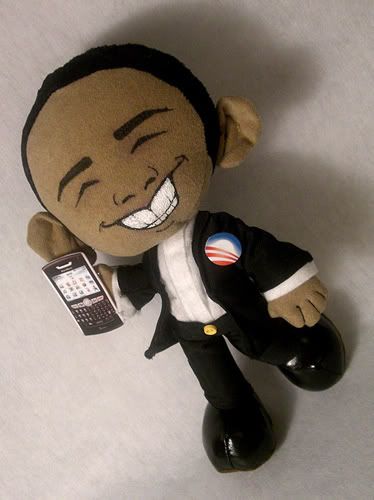
Obama: The Unofficial Commemorative Plushie

OK. Today is historic. I get that. And people are excited about it. I get that, too. What I do not get, however, is the vast and diverse array of "commemorative" items that people are shilling for Obama's inauguration as our 44th president. Just perform a Google search on "obama commemorative" and you will see about 868,000 results. If you want to narrow it down to items you can actually purchase (or, rather, items that include the correct metadata to be pooled under shopping results), click Google's shopping link. Still, it's just under 10,000 (I got 9,778 results). But among the plates, cups, coins, and clocks (yes, clocks!), I did not see an official Obama plushie. Not in the top 50 at any rate. Now, it's not that I actually want an Obama plushie. I just became curious after seeing this particular LiveJournal post. Hence my entry's use of "unofficial" in the title. Seems that at least one LJ user is so excited about President Obama, is so enamored of him, that she created her very own tribute in the form of a plushie doll. Oh, and it comes complete with a Blackberry:
http://img.photobucket.com/albums/v654/hollyz3/Obama_1.jpg
Now, I say she created her very own plushie, but it might be more accurate to say that she created "your" very own plushie. And by that, I mean they put it up for auction on eBay. Starting bid: 99 cents. Oh, and before you go looking for that auction, hoping to get your bid in ... the auction is over. It ended on January 18, with 27 bids. High bidder took the plushie for a capitalist-friendly final bid of $91.00.
[Click for larger image]
Remember kids: This is not a toy. It's a piece of hand crafted artwork (It's fanart! It's homemade!). This is not intended for children. Nor is it intended to make a mockery of the office of the President of the United States. Really, it's not.
http://img.photobucket.com/albums/v654/hollyz3/OBAMA_BANNER.jpg?t=1232469173 [Click for larger image]

Monday, December 15, 2008

Ancient Roman Battlefield Provides New Insights

Here is some interesting archaeological news from the weekend...
Ancient Roman battlefield excavated in Lower Saxony
http://www.thelocal.de/articleImages/16075.jpg A Roman dagger from another dig near Hedemünden. Photo: DPA
Archaeologists have discovered an ancient roman battlefield from the third century near Göttingen that will rewrite history, Lower Saxony's department for preservation of historical monuments said on Thursday. “The find can be dated to the third century and will definitely change the historical perception of that time,” Dr. Henning Haßmann told The Local. The amazing discovery allows an insight in what must have been a dramatic battle between Romans and Germanic tribes. “The find indicates a massive Roman military presence,” Haßmann said.
Read the whole thing: http://www.thelocal.de/sci-tech/20081211-16075.html

Monday, November 24, 2008

Book Review | Finding Merlin

[This review is by Nick Owchar of the LA Times. I have not yet read the book, but I do have a slight interest.]

In search of a wizard

In 'Finding Merlin: The Truth Behind the Legend of the Great Arthurian Mage,' Adam Ardrey condemns long-ago chroniclers for their motives but is like a sleuth in tracking ancient details.
By Nick Owchar November 23, 2008
Think of your favorite movie Merlin: Was it Sam Neill's Tolkienesque version (see photo) or was it "Excalibur's" Nicol Williamson, with that unforgettable steel skullcap? How about Stephen Dillane's blue-faced portrayal in the 2004 box office disappointment "King Arthur"? (The movie didn't disappoint me, Keira Knightley was in it.) Adam Ardrey would have none of them, and very little of all the other Arthuriana that's out there -- not T.H. White's "The Once and Future King," not Tennyson's "Idylls of the King," Thomas Malory's epic, "Le Morte D'Arthur," not even Marion Zimmer Bradley's "The Mists of Avalon."
The author of "Finding Merlin: The Truth Behind the Legend of the Great Arthurian Mage" (The Overlook Press: 384 pp., $24.95) would say that any adult interested in these inventions must be emotionally trapped in junior high. Oh, and they've probably also participated (at least once) in one of those silly medieval warfare reenactments. Excuse me while I adjust my chain-mail pants. And yet, above his clear distaste for the popular versions of this legend -- and he doles out plenty of this in his new book -- there is a fascinating question which he pursues with zeal: Just who was Merlin, really?
The answer Ardrey's book provides is that the real Merlin was something of a scientist and Druid leader who helped the Scots and Britons fight off the Angles in the aftermath of Roman occupation. For his efforts, though, Ardrey says Merlin's contributions were written out of early English chronicles or, when he is found, he is reduced to an insulting form -- a wildman or a madman of some kind... [Read More]

Monday, October 06, 2008

German-American Day!

[This is a mildly edited re-post of a previous blog entry]

Here in the USA, today, October 6, is ... German American Day! How wunderbar to start the week off this way! In 1987 Congress enacted Public Law 100-104 designating October 6 as German-American Day:
A proclamation was issued by President Reagan in a Rose Garden Ceremony calling on the American people to observe this day with appropriate celebrations and activities. The date was chosen because on October 6, 1683 the first group of Germans sailed into Philadelphia Harbor on the Concord. Individually Germans had arrived before that date. [German-American Day Teaching Unit]
Since that date, every U.S. president has made a proclamation that October 6 is German-American day, a day to honor and remember the outstanding, significant, and lasting contributions that German immigrants made to our country. For more information on German contributions to the United States, or for activities to celebrate German-American Day, I offer the following links: And, yes, I am of German descent and I am quite proud of my heritage. So, to all my family, kin, and friends -- and even to those of you who are not lucky enough to have even the smallest drop of German blood flowing in your veins -- I wish you a great day.
Haben Sie einen großen Tag!

Tuesday, July 22, 2008

David Brown Book Company: Book Sale!

If you are interested in topics related to Early Medieval Europe, then the David Brown Book Company has a sale for you. Click the link for a full list. Some of these sale prices are even better than the used book prices at amazon.com! David Brown Book Company - Sale Bargains - Early Medieval Europe

Wednesday, July 16, 2008

At the heart of a Folk Art -- themorningcall.com

Mariella Savidge of The Morning Call writes of Pennsylvania Dutch Hex Signs, and points to Lehigh and Berks counties as being "at epicenter of hex sign culture". At the heart of a Folk Art -- themorningcall.com [Broken link -- update below for text of story] An interview subject--Patrick Donmoyer, a student at Kutztown University--seems to hedge around the question of the art's pagan origins. Still, it's a pretty good read and a great intro for people who appreciate the art but have not delved too deeply into its meaning or history. More stuff:
=================================

Update: October 16, 2008 -- This story is no longer present in the Morning Call's archive, but the multimedia tour is still available. Full text of original story posted below...

PENNSYLVANIA DUTCH HEX SIGNS 
At the heart of a Folk Art 
Lehigh, Berks counties are at epicenter of hex sign culture 

By Mariella Savidge | Of The Morning Call 
July 15, 2008 

The Pennsylvania Dutch influence on the Lehigh Valley shines through in any number of ways: the food, the festivals, the language. A part of the culture's very soul, however, are hex signs -- the brightly colored circles that are most authentic when painted on barns but also are very popular on decorative wooden discs. Few people realize that eastern Berks and western Lehigh counties are the epicenter of the indigenous folk art form. Though there are a few in Lancaster County, they are exclusive to the Pennsylvania Dutch even there, and have nothing to do with Amish culture, says Don Yoder, co-author with Thomas E. Graves of ''Hex Signs: Pennsylvania Dutch Barn Symbols & Their Meaning'' (Stackpole Books, second edition 2000). 

"Hex signs and Amish don't mix,'' he says. The Amish and Mennonites are two distinct, smaller groups included in the much larger category of European immigrants called the Pennsylvania Dutch, or Pennsylvania German. The term ''Dutch'' once covered people who were German or Dutch. Because of their somber dress, the Amish and Mennonites are sometimes called the ''plain'' Dutch. The ''fancy'' Dutch are mostly Lutheran and Reformed Church members. Amish barns typically are white and trimmed with green. They display no ''fancy'' decoration whatsoever, says Patrick J. Donmoyer, a student at Kutztown University majoring in art and minoring in Pennsylvania German Studies. His honors project this summer involves cataloging all the barns with hex signs in Berks County. 

Pennsylvania Dutch barns usually are red, owing to the low price and easy availability of the pigment just after the Civil War, says artist Eric Claypoole, who learned to paint hex signs by watching his father in the family's Greenwich Township home. Each symbol has a meaning, Claypoole explains: Hearts stand for romance and love of mankind, distlefinks -- stylized goldfinches -- signify abundance (but with eyes looking backward toward Germany). Snakes symbolize temptation. The Pennsylvania Dutch decorated everything with these symbols, furniture, birth certificates, even Bibles, he says. The concept of using the symbols for good luck or to ward off evil was publicly introduced in Wallace Nutting's 1924 book, ''Pennsylvania Beautiful,'' where he called the designs ''hexafoos,'' or witch's foot. He coined the ''hex sign'' moniker for the images that had previously been known simply as schtanne and blumme, stars and flowers. Claypoole breaks a sly smile when asked if he attaches any meaning other than decoration to his work, probably the same smile generations of farmers gave before they answered, ''Yuscht fer schee'' -- just for nice, the answer he always gives. Yoder, whose book is still the go-to source for information on hex signs decades after it was first published, plays down their mystical properties. He does, however, acknowledge the designs were used on the underside of furniture, the backs of mirrors and on paper rolled into scrolls that homeowners inserted into holes drilled into door frames and window lintels (with the hope that they would protect their houses). On barns, farmers were using hex signs simply to show ''that they cared about the aesthetics of the landscape.'' ''But use these designs on barns to keep witches away? No!'' Yoder writes. 

He also writes that the story of hex signs still is being written. At age 22, Donmoyer is poised to be among the prime champions who continue the story. He lectures on the meaning of ''hexerei'' (hex signs) and continues to dig deep into their rich history. Some of the symbols, he says, date back to Norse, and even pagan, art. And it is no coincidence that the hub of hex sign activity is here rather than, say, New York or New Jersey. ''There was freedom of religion in Pennsylvania,'' he says. ''People were afraid of so many things. Even 'witches' were protected here.'' Donmoyer notes hex signs might be for more than just decoration and there could be a link to powwowing, a Pennsylvania German practice of healing using a core group of prayers. The practice was driven underground, where it remains today. Statements by other hex sign experts that the signs couldn't have mystical meanings because they're so public and out there for the world to see are misleading, Donmoyer says. While many can be seen from main roads, many are painted on the other side of the barn, which only could be seen by the family, he says. Protecting a barn -- the center of a farmer's life and livelihood -- from witches, even if they were only people who were very attuned to animals or nature, may or may not be whimsical. ''But witches were not the only reason to protect a barn,'' he says, referring to theft, fire and disease as other tragedies that could befall a farm or a home. 

Although the exact meaning of hex signs may be known only to the farmers who painted them so many years ago, they are interesting and worth studying, he says. ''So many areas don't have something like this,'' he says, ''It's worth the time to approach them with gratitude.'' mariella.savidge@... 610-778-2253 


WHAT THE SYMBOLS MEAN 

The most authentic hex signs are painted onto barns and are said to invite good luck while keeping away evil and tragedy. Some of the most frequently used designs have specific meanings, though there is no verifiable source for any of them:
  • 4-point star: the four seasons, good luck
  • 5-point star: protection against evil, five senses, good luck
  • Double 5-point star: sun and light
  • 6-point star: prosperity, good luck, protection from lightening, perfect marriage
  • 6-petal rosette: faith, fertility, protection from harm. One of the most common symbols, it is said to be one of the most ancient.
  • 8-point star: fertility, perseverance
  • 12-point star: the months of the year, rationalism, justice
  • Hearts: love
  • Raindrops: fertility, abundance
  • Tulips: faith, hope and charity; the holy trinity
  • Oak leaves: strength
  • Maple leaves: contentment
  • Distlefinks: (goldfinches) abundance, good luck, happiness
  • Snakes: temptation
  • Scalloped edge (waves): tranquility, smooth sailing
  • Closed circle edge: eternity
Various sources 


COLORS 

Hex sign colors, as well as shapes, have meanings. In fact, they usually emphasize the meaning of the symbols. Although there are no verifiable sources, these are the meanings that folklore has conveyed to generations of Pennsylvania Dutch families:
  • Red: love
  • Orange: success, career
  • Yellow: health, sun
  • Green: growth, good fortune, fertility
  • Blue: protection, peace, calm, spirituality
  • Purple: spirituality, intuition, sanctity
  • Brown: earth, nature
  • White: purity, free flow of energy
  • Black: protection
Various sources

Thursday, June 19, 2008

The Web that Time Forgot

The International Herald Tribune has a story on a technology pioneer Paul Otlet, who imagined a "Steampunk version of hypertext" more than 50 years before the first Web browser was released. Check it out: The web that time forgot - International Herald Tribune
The telegraph room at the original Mundaneum in Brussels. (Mundaneum)

Monday, March 31, 2008

Grave Thoughts on Nietzsche

Nietzsche's grave in the churchyard of Rocken, Germany, might have to be moved so that a power company can access a vein of coal running beneath it. Ben MacIntyre of The Times muses that digging up the German philosopher might present an opportunity to save him from his sister ... and the unkind ravages of history. Of Nietzsche's sister Elisabeth, MacIntyre writes that she was "a lifelong anti-Semite who hijacked her brother's writings after his death and used them to serve the cause of Nazism, leaving a stain on his philosophy that has never been fully erased." That stain is very much undeserved, for as MacIntyre explains:
Nietzsche was no Nazi. He vigorously opposed German nationalism, as he rejected all mass movements; he had no time for ideologues, mocked the notion of a Teutonic master race and loathed anti-Semitism in all its forms.
Usually, I am against exhuming remains, particularly when the disturbance serves only to clutch greedily at more mineral rights. But in this case, I stand with MacIntyre and would welcome this action. But only if the philosopher's reburial was performed in accord with his own recorded wishes and, as MacIntyre has suggested, his memory is cleansed as well. Read more: Nietzshe and His Nazi Sister

Wednesday, February 06, 2008

Stranger than Fiction

Have you read about the poll that indicates almost a quarter of all Britons believe that Winston Churchill was a fictional character? Did you know that this same poll shows that a majority think Sherlock Holmes was a real detective? UKTV Gold television surveyed 3,000 people and found a disturbing number of people confuse fictional characters with real ones. Go check it out for a few more examples of twisting history with fiction.