 |
| Holiday candle (Free photobank www.tOrange.us) |

Showing posts with label pluralism. Show all posts
Showing posts with label pluralism. Show all posts
Thursday, December 24, 2015
Whose Holiday Is This Anyway? [Redux]

Sunday, March 16, 2014
A New Breastplate (And a Message for St. Patrick) Redux
Labels:
Christianity,
faith,
heathen,
Holiday,
Pagan,
pluralism,
religious freedom

Patrick, if you truly existed (even if only as a composite of several individuals as I suspect), I have a message for you. Neither you nor your brethren drove out the "snakes" -- you merely forced them undergound. Nor did you eliminate their traditions. In fact, your beloved Church is riddled with more of my ancestor's traditions than those of the early Christians, and by this I am referring to practices from the first few decades of Christianity, or "the Way of Yeshua" as it was likely known by its earliest adherents. And in case you missed it, Patrick. The "snakes" are back. We are back, and every year our numbers grow as more people awaken to the old ways -- be they Celtic, Germanic, Slavic, Romanic, etc. -- and make them relevant today. For our ways are relevant as they are a means of being in this world, being with it, and not trying to simply control it or ignore it in the hope of achieving some afterlife. Originally written and posted in 2008, "A Heathen's Breastplate" is still appropriate to post now:
The Lorica (or Breastplate) is a prayer written in Irish and Latin that is often attributed to Saint Patrick. There are many variations of it (one can be found here), but I have decided to rewrite it in "honor" of the old saint who is said to have driven out the pagans. Now it has a nice Heathen slant...A Heathen's Breastplate
I arise today
Heir to the strength of Asgard;
Light of the sun,
Splendor of fire,
Swiftness of wind,
Depth of the sea,
Stability of earth,
Firmness of rock.
I arise today with mine own strength to pilot me;
Thor's might to uphold me,
Frigga's wisdom to guide me,
Odin's hand to guard me,
Heimdall's watch to shield me,
Freyr's vitality to sustain me,
And Freya's love to bless me.
Afar and anear,
Alone or in a multitude.
The ancestors are with me,
before me, behind me,
on my right, on my left.
As sure as
The Earth beneath me,
The Sky above me,
The Holy Powers within me.
I arise today
Rooted in the mighty traditions of my past.
And I walk Midgard,
Sending forth the blessings of this day's deeds to generations yet unborn.
copyright 2008 and 2010, BSW

Tuesday, March 20, 2012
Hail Spring!

On this, the day of the Spring Equinox, I wish the blessings of Ostara (Eostre, Oschder, Alban Eilir, etc.) upon all my family, friends, and kindred spirits. Here is a little something I wrote for an Ostara observation in 2008 (it was later featured on this blog in 2009):
Frigga, ever wise, Mother of all
Freya, our Lady of love, beauty, and fertility
Nerthus, earth Mother, womb of the world
Sunna, Lady of the heavens, bright and glorious in your return
Ostara, the spring Maiden, it is in your name we gather this day
Winter is over
The land is awakened with your creative and sustaining powers
Flowers long to bloom
The light quickens, lengthening the days
And, soon we hope, warming them as well.
Thus the cycle continues.
Spring is nigh upon us:
Ostara takes root in our hearts
And then blossoms in our deeds.
We depart knowing her blessings.
© Brian Weis 2008
Wednesday, March 14, 2012
A New Breastplate (And a Message for St. Patrick) Redux
Labels:
Christianity,
faith,
heathen,
Holiday,
Pagan,
pluralism,
religious freedom
[This post is a slightly updated version of one that I published on 3/17/2009.]
Patrick, if you truly existed (even if only as a composite of several individuals as I suspect), I have a message for you. Neither you nor your brethren drove out the "snakes" -- you merely forced them undergound. Nor did you eliminate their traditions. In fact, your beloved Church is riddled with more of my ancestor's traditions than those of the early Christians, and by this I am referring to practices from the first few decades of Christianity, or "the Way of Yeshua" as it was likely known by its earliest adherents. And in case you missed it, Patrick. The "snakes" are back. We are back, and every year our numbers grow as more people awaken to the old ways -- be they Celtic, Germanic, Slavic, Romanic, etc. -- and make them relevant today. For our ways are relevant as they are a means of being in this world, being with it, and not trying to simply control it or ignore it in the hope of achieving some afterlife. Originally written and posted in 2008, "A Heathen's Breastplate" is still appropriate to post now:
The Lorica (or Breastplate) is a prayer written in Irish and Latin that is often attributed to Saint Patrick. There are many variations of it (one can be found here), but I have decided to rewrite it in "honor" of the old saint who is said to have driven out the pagans. Now it has a nice Heathen slant...A Heathen's Breastplate
I arise today
Heir to the strength of Asgard;
Light of the sun,
Splendor of fire,
Swiftness of wind,
Depth of the sea,
Stability of earth,
Firmness of rock.
I arise today with mine own strength to pilot me;
Thor's might to uphold me,
Frigga's wisdom to guide me,
Odin's hand to guard me,
Heimdall's watch to shield me,
Freyr's vitality to sustain me,
And Freya's love to bless me.
Afar and anear,
Alone or in a multitude.
The ancestors are with me,
before me, behind me,
on my right, on my left.
As sure as
The Earth beneath me,
The Sky above me,
The Holy Powers within me.
I arise today
Rooted in the mighty traditions of my past.
And I walk Midgard,
Sending forth the blessings of this day's deeds to generations yet unborn.
copyright 2008 and 2010, BSW
Monday, May 09, 2011
May 9: Hail Guthroth!
Labels:
Asatru,
Christianity,
history,
pluralism,
religious freedom
May 9 is a Day of Remembrance for Guthroth. Please refer to my 2007 post for details and helpful links.
Friday, April 02, 2010
30 days of Advocacy against Witch-Hunts in Africa
Labels:
controversy,
faith,
heathen,
Pagan,
pluralism,
religious freedom
 The South African Pagan Rights Alliance would like to request you to support an annual 30 day advocacy campaign against witch-hunts in Africa from March 29 through April 27, 2010.
For more information on the campaign, a list of hunting incidents that have occurred just this year, and a collection of advocacy links, go to the Facebook Event: http://www.facebook.com/event.php?eid=274505543709
Sign up, sign the petition, and spread the word.
The South African Pagan Rights Alliance would like to request you to support an annual 30 day advocacy campaign against witch-hunts in Africa from March 29 through April 27, 2010.
For more information on the campaign, a list of hunting incidents that have occurred just this year, and a collection of advocacy links, go to the Facebook Event: http://www.facebook.com/event.php?eid=274505543709
Sign up, sign the petition, and spread the word.
Monday, December 21, 2009
Solstice Musings around the Web
 Here are a few more Solstice-oriented blog posts for your reading pleasure:
- A Blessed Solstice -- Jason does a nice job of summarizing the basic Pagan views around observing the Solstice.
- The Reason for the Season [Redux] -- Hrafnkell brings his A-game to this well-researched piece on where the holiday season came from. Check out the "identity theft" angle he uses to great effect.
- Winter Solstice 2009 -- A heartbreaking and personal blog entry that shows just how hopeful this season can be even in the midst of personal crisis.
Whose Holiday Is This Anyway? [Redux]
Labels:
Asatru,
Christianity,
Christmas,
discuss,
faith,
history,
Holiday,
interfaith,
Nordic,
Pagan,
pluralism,
religious freedom,
Yule
We're knee-deep in the holiday season now -- Hanukkah has passed, the Winter Solstice is upon us, and Christmas is right down the stretch of this week -- so now seems like the right time to re-post a little something I wrote in 2004. This time around I have included links to "4000 Years of Christmas" and a video performance of Dar Williams' "The Christians and the Pagans." I have also changed "Chrismahanukwanzakah" to "Chrismahanukwanzakyule" as it better expresses my pluralist leanings.
I hope you enjoy this holiday rewind...
Whose Holiday Is This Anyway?
This is a response to the various and recent vents in my local paper about the current holiday season. Specifically, I want to address the memes of "Keeping the Christ in Christmas" and "Jesus is the reason for the season." Before I begin, however, I must point out that I love this holiday season, and I care not one whit whether someone wishes me Seasons Greetings, Happy Holidays, Joyous Yule, or any of the countless other phrases in use. I'll take them all in the spirit intended. I'll even return a cheery Merry Christmas in kind to someone who proffers it. That's right, I'm no Scrooge who thinks that "every idiot who goes about with ‘Merry Christmas’ on his lips should be boiled with his own pudding, and buried with a stake of holly through his heart" [A Christmas Carol].
Tuesday, November 17, 2009
Indianapolis Public Schools Censoring Pagan Content?
The Wild Hunt Blog, a respected source of Pagan news and commentary, directed me to this story. Like many public schools, the Indianapolis Public School system has employed web filters on school computers. Despite the known problems, this has become a fairly standard practice in schools. What is at issue here, however, is that "almost all of the most popular Internet filters block Pagan sites" [religioustolerance.org]. Refer to the Wild Hunt's reporting for the full story and a hopper full of background linking:
The Wild Hunt » Indianapolis Public Schools Block the Pagans
The Wild Hunt also raises an interesting question in the midst of all the cyber legalities: Did the school officials in question :put [this policy] place because [they were] "anti-atheist and anti-Pagan, or ... simply lazy"? I am willing to lean toward lazy in this case, but I'm just going by my gut. I have no evidence or reason to believe the school actively condemns expressions of spirituality. It is very likely just the side effect of a budgetary consideration.
 Photo by RIUM+ / CC BY-SA 2.0
Photo by RIUM+ / CC BY-SA 2.0
Friday, May 01, 2009
(Separation of) Church & State for May 2009
Labels:
Christianity,
controversy,
faith,
interfaith,
pluralism,
politics,
religious freedom
The May 2009 edition of Church & State, the monthly publication from Americans United for Separation of Church and State, is now online. Top stories include:
Visit now: http://www.au.org/site/PageServer?pagename=cs_2009_05
- Special Delivery: Letters From AU’s Legal Department Solve Church-State Problems In Public Schools Without Going To Court
- A+ Arizona: State Supreme Court Flunks Voucher Subsidies For Religious And Other Private Schools
- Power Struggle: With James Dobson Inching Toward Retirement And Others Off The Scene, Many Wonder Who Will Fill The Religious Right’s Bully Pulpit
- Texas Two-Step: State School Board Takes One Step Forward On Science Standards – And Two Steps Back

Thursday, April 30, 2009
Raise the Hammer for Vets!
Labels:
Asatru,
faith,
heathen,
interfaith,
Pagan,
pluralism,
religious freedom
After defending our nation, and paying the ultimate sacrifice, our veterans should be honored and remembered by the symbol of their chosen faith. Raise the hammer for them!

Thursday, April 16, 2009
Red Thor Takes the Wheel
Hrafnkell has a nice reworking of Jesus Take the Wheel. In his capable hands, the lyrics are transformed from whiny to empowering. Take a look at Red Thor Ward My Steps.
Thursday, April 02, 2009
Church & State for April 2009
Labels:
Christianity,
controversy,
faith,
interfaith,
pluralism,
politics,
religious freedom
The April 2009 edition of Church & State, the monthly publication from Americans United for Separation of Church and State, is now online. Top stories include:
 Visit now: http://www.au.org/site/PageServer?pagename=cs_2009_04
- Touchdown At The Supreme Court
- Fighting ‘Faith-Based’ Bias
- High Court Commandment
- Senate Voucher Victory
Wednesday, March 25, 2009
Blaze of Glory
Labels:
Asatru,
controversy,
culture,
europe,
heathen,
pluralism,
religious freedom
I'm blogging this article for two reasons:
- It mentions Ásatrú.
- It concerns a matter of religious freedom/choice.
Hindus In Britain Demand Traditional Cremation

More:
- wikipedia entry on "Cremation"
- Death in Banaras (scholarly treatise on why Hindus cremate their dead)
- Internet Cremation Society
- Cremation versus Burial (Mainly concerned with Jewish/Christian burial at ReligiousTolerance.org)
- "Beowulf" and Cremation
Monday, March 23, 2009
Pagans in ... Israel?
The headline brazenly proclaims, "Paganism returns to the Holy Land," but the truth is so much more subtle.
Of course, one could make the argument that paganism never really left Israel. That, at most, it was driven underground. And that seems to be the way things still are. Consider the following quotes from Ofri Ilani's article:
- ...most Israeli pagans reveal their beliefs only to those who share them. They usually keep religious gatherings ... secret.
- "Some guys live with religious families. They can't tell their parents, 'I don't believe in Judaism, I'm a pagan.' They'd chop off their heads."
- "In a country like ours ... being a pagan is not easy ... Worshiping other gods is something very sensitive in Judaism. We all were educated [to think] this is intolerable and illogical."
- "...Judaism has only one god, and if you do not believe in him, you will be driven off with stones."
Friday, March 20, 2009
Hail Spring!
On this, the day of the Spring Equinox, I wish the blessings of Ostara (Eostre, Oschder, Alban Eilir, etc.) upon all my family, friends, and kindred spirits.
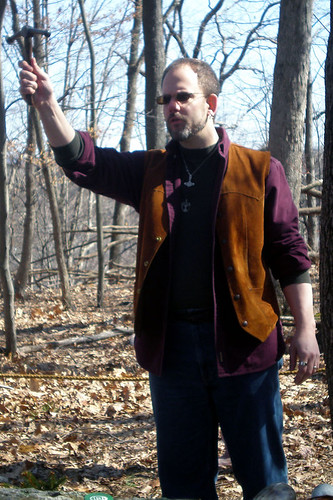
Words: © Brian Weis 2008
photo credit: Frank Black 2008
Frigga, ever wise, Mother of all
Freya, our Lady of love, beauty, and fertility
Nerthus, earth Mother, womb of the world
Sunna, Lady of the heavens, bright and glorious in your return
Ostara, the spring Maiden, it is in your name we gather this day
Winter is over
The land is awakened with your creative and sustaining powers
Flowers long to bloom
The light quickens, lengthening the days
And, soon we hope, warming them as well.
Thus the cycle continues.
Spring is nigh upon us:
Ostara takes root in our hearts
And then blossoms in our deeds.
We depart knowing her blessings.
Freya, our Lady of love, beauty, and fertility
Nerthus, earth Mother, womb of the world
Sunna, Lady of the heavens, bright and glorious in your return
Ostara, the spring Maiden, it is in your name we gather this day
Winter is over
The land is awakened with your creative and sustaining powers
Flowers long to bloom
The light quickens, lengthening the days
And, soon we hope, warming them as well.
Thus the cycle continues.
Spring is nigh upon us:
Ostara takes root in our hearts
And then blossoms in our deeds.
We depart knowing her blessings.
Words: © Brian Weis 2008
photo credit: Frank Black 2008
Tuesday, March 17, 2009
A New Breastplate (And a Message for St. Patrick)
Labels:
Christianity,
faith,
heathen,
pluralism,
religious freedom
Ah, yes. Today is St. Patrick's Day. Well, I for one will not be putting on the green and celebrating. I do not celebrate the lives (real or imagined) of those who tried to put down my ancestral faith. (For those of you who didn't realize, the driving out the snakes thing is most likely a metaphor for stomping out the ethnic and traditional practices of the Irish people).
Patrick, if you truly existed (even if only as a composite of several individuals as I suspect), I have a message for you. You did not drive out the "snakes" -- you merely forced them undergound. Nor did you eliminate their traditions. In fact, your beloved Church is riddled with more of my ancestor's traditions than those of the early Christians, and by this I am referring to practices from the first few decades of Christianity, or "the Way of Yeshua" as it was likely known by its earliest adherents.
And in case you missed it, Patrick. The "snakes" are back. We are back, and every year our numbers grow as more people awaken to the old ways -- be they Celtic, Germanic, Slavic, Romanic, etc. -- and make them relevant today. For our ways are relevant as they are a means of being in this world, being with it, and not trying to simply control it or ignore it in the hope of achieving some afterlife.
Originally written and posted last year, "A Heathen's Breastplate" is still appropriate to post on this day:
The Lorica (or Breastplate) is a prayer written in Irish and Latin that is often attributed to Saint Patrick. There are many variations of it (one can be found here), but I have decided to rewrite it in "honor" of the old saint who is said to have driven out the pagans. Now it has a nice Heathen slant...
A Heathen's Breastplate
I arise today
Heir to the strength of Asgard;
Light of the sun,
Splendor of fire,
Swiftness of wind,
Depth of the sea,
Stability of earth,
Firmness of rock.
I arise today with mine own strength to pilot me;
Thor's might to uphold me,
Frigga's wisdom to guide me,
Odin's hand to guard me,
Heimdall's watch to shield me,
Freya's love to bless me.
Afar and anear,
Alone or in a multitude.
The ancestors are with me,
before me, behind me,
on my right, on my left.
As sure as
The Earth beneath me,
The Sky above me,
The Holy Powers within me.
I arise today
Rooted in the mighty traditions of my past.
And I walk Midgard,
Sending forth the blessings of this day's deeds to generations yet unborn.
copyright 2008, BSW
Tuesday, February 24, 2009
What Ancient Heathen Practices Do We Keep?
[The original version of this essay was submitted to my mentor in the Clergy Program. I was asked whether I could clearly state "what aspects of our ancient practices we wish to keep and which we do not? What policy would you formalize that would help you tell someone else when they should accept a practice and not accept other practices or beliefs of our ancestors?"]
I have been wrestling with this set of questions for a few weeks. I must admit, however, that even after accepting the assignment, I felt that trying to work out a coherent, reasonable approach seemed far too huge a task for me. Truly, who am I to answer such questions? The first strike against me is that I have only been involved in the tradition for a short time. Other folks had been actively researching and promoting the religion, even starting organizations and writing books, well before I knew of it. Strike two is my lack of proficiency in the lore. I do work to regularly add to my knowledge, and I love to do the readings, but the simple fact remains that I am not a "lore hound" -- that is, I do not have a vast repository of lore or historical data committed to memory.
And the third strike?
I actually got well beyond a third strike against myself. But then I started to calm down a bit. I realized that, although there were others who were superior to me in knowledge, I have a sincere desire to be of service to the Gods and Goddesses and all who approach them. I have been serving in this capacity, albeit with small steps, and no one has questioned my capabilities or worthiness to do so. I further realized that the questions that lead this piece are the very questions that everyone involved in the Reconstruction must answer. And we must continue to evaluate and answer these questions as the movement grows and matures, as new folks are awakened to the path. And if I am going to be successful in my service, I must be part of the conversation regarding those questions.
Third -- and here I am continuing my previous meme of the three strikes, but now in a positive bend -- I realized that this query really boils down to a single question: What ancient practices are relevant today?
Although I have already taken a tangential path to bring several questions down to one, I am going on another slight tangent. I believe it will serve a useful purpose, and I hope that will be evident when I return to answering the question of relevant practices. During my brief forays into studying theology, and by that I do actually mean theology of a Christian persuasion, I came across an interesting approach to Biblical interpretation. I say it was interesting because I felt that the approach, although espoused by two Evangelical theologians, could be applied to the study of just about any "scriptures" -- please note the use of quotes here implies that while not all faith traditions can be said to have their own scriptures, as the Abrahamic faiths do, many of them do have writings of some form or at least some historic record to be translated and interpreted for a modern audience. I recall that one of the instructors referred to the method as a triangle because it had three points. I cannot remember what specific name, if any, he gave the triangle -- I have the lecture recorded somewhere, but cannot find it or my notes. I do, however, remember the basic gist. And it goes something like this: When considering a writing of a spiritual nature (or even one of historical record), one has to approach it in light of its literal context, historical context, and eternal context. In other words:

Next I will show the model in use in evaluating two practices.
What Ancient Heathen Practices Do We Keep?
What aspects of our ancient practices do we wish to keep? Which ones can we discard? How do we determine which beliefs and practices we should accept?I have been wrestling with this set of questions for a few weeks. I must admit, however, that even after accepting the assignment, I felt that trying to work out a coherent, reasonable approach seemed far too huge a task for me. Truly, who am I to answer such questions? The first strike against me is that I have only been involved in the tradition for a short time. Other folks had been actively researching and promoting the religion, even starting organizations and writing books, well before I knew of it. Strike two is my lack of proficiency in the lore. I do work to regularly add to my knowledge, and I love to do the readings, but the simple fact remains that I am not a "lore hound" -- that is, I do not have a vast repository of lore or historical data committed to memory.
And the third strike?
I actually got well beyond a third strike against myself. But then I started to calm down a bit. I realized that, although there were others who were superior to me in knowledge, I have a sincere desire to be of service to the Gods and Goddesses and all who approach them. I have been serving in this capacity, albeit with small steps, and no one has questioned my capabilities or worthiness to do so. I further realized that the questions that lead this piece are the very questions that everyone involved in the Reconstruction must answer. And we must continue to evaluate and answer these questions as the movement grows and matures, as new folks are awakened to the path. And if I am going to be successful in my service, I must be part of the conversation regarding those questions.
Third -- and here I am continuing my previous meme of the three strikes, but now in a positive bend -- I realized that this query really boils down to a single question: What ancient practices are relevant today?
Although I have already taken a tangential path to bring several questions down to one, I am going on another slight tangent. I believe it will serve a useful purpose, and I hope that will be evident when I return to answering the question of relevant practices. During my brief forays into studying theology, and by that I do actually mean theology of a Christian persuasion, I came across an interesting approach to Biblical interpretation. I say it was interesting because I felt that the approach, although espoused by two Evangelical theologians, could be applied to the study of just about any "scriptures" -- please note the use of quotes here implies that while not all faith traditions can be said to have their own scriptures, as the Abrahamic faiths do, many of them do have writings of some form or at least some historic record to be translated and interpreted for a modern audience. I recall that one of the instructors referred to the method as a triangle because it had three points. I cannot remember what specific name, if any, he gave the triangle -- I have the lecture recorded somewhere, but cannot find it or my notes. I do, however, remember the basic gist. And it goes something like this: When considering a writing of a spiritual nature (or even one of historical record), one has to approach it in light of its literal context, historical context, and eternal context. In other words:
- What is the literal meaning of the passage?
- What did it mean to the original hearers?
- What does it mean today? (The Christian approach tries to determine the "eternal truth" or meaning of the passage for all time. But I would simply look for a relevant modern meaning.)

Next I will show the model in use in evaluating two practices.
Ancient Practice Analysis #1: Bog Justice According to the Free Dictionary, a Bog Body is any one of the approximately 700 preserved human remains found in natural peat bogs, mostly in western Europe, from about c. 8000 BC to early medieval times. "That they have been variously found with cut throats, severed limbs, ropes around the neck, and so on suggests the possibility of ritual killings, murders, and ignominious burial (since none was found within a proper grave)" [thefreedictionary.com]. There is debate as to whether these bodies represent certain evidence of executions for a crime, sort of a "bog justice" if you will, or as a human sacrifice, or something else entirely. Even with the debate, the fact that our ancestors seemed to have a practice, even minimally so, of placing bodies into bogs will suffice for the purpose of analysis.
Q1: What is the literal meaning of placing a body into a peat bog? A: It is a dead body dumped into a bog. It is not a pleasant burial.
Q2: What is the historical meaning (i.e., what did it mean to our ancestors)? A: I will use the Free Dictionary information here and conclude that this is an "ignominious burial." While we cannot know for certain, in looking at other historical records, we can safely assume that this was not a desired end. It was likely something to be avoided.
Q3: What is the modern relevance of bog justice? A: Modern relevance in killing someone and dumping the body? If we are to assume an historical basis of justice, then the modern relevance would be retribution, or perhaps vigilante justice. In either case, it would be an extreme punishment.
Q4: Is bog justice practical today? A: It is neither practical nor feasible. Our modern society has a legal system for addressing grievances and crimes. And as flawed as it may be, it is a system we have to work within, otherwise our actions will be branded as criminal and then we will be subject to it (the system). Besides, depending on one's geography, a peat bog might be very difficult to find. A similar analysis can be applied to the concept of raiding, and the same conclusion can be drawn: it is not practical in today's global society. (Greg Shetler briefly covers this very topic in his book, "Living Asatru").
Ancient Practice Analysis #2: Animal Sacrifice Animal sacrifice is the ritual consecration, killing, and then offering of an animal to some form of divinity. Depending on the tradition, this was (and, in a small number of cases, is still) done to appease or maintain favor with the divinities. Animal sacrifice has a long history in poly- and monotheistic traditions. [More information: Pagan Institute: Animal Sacrifice and About - Alt Religion - Which Religions Involve Animal Sacrifice.]
Q1: What is the literal meaning of sacrificing an animal to the Gods and Goddesses? A: It is a communal giving of a gift to higher powers.
Q2: What is the historical meaning of animal sacrifice (i.e., what did it mean to our ancestors)? A: A sacrifice of this nature was not taken lightly. It was a "gift for a gift" -- a gift with a very high price. Additionally, our ancestors believed that blood was a very powerful gift because it represented life itself.
Q3: What is the modern relevance of animal sacrifice? A: In this case, I feel that the modern and ancient meanings are roughly equivalent. However, there is little question as to which perspective placed a greater value on the sacrifice. For our ancestors, giving up an animal to sacrifice was a risky prospect and it bespoke a great trust in the natural powers to provide. Today, we have convenience stores and giant grocery outlets -- and most of us do not grow or raise our own food.
Q4: Is animal sacrifice practical today? A: From my perspective, living and working as I do in the post-agricultural (even post-industrial) world, animal sacrifice is not practical or feasible. I could follow one of the alternative practices, such as making a bread or cake "animal" and sacrificing it. or making a work of art and offering it up. But I do not have the resources or knowledge to raise an animal for sacrifice, nor do I have the proper training do conduct such a sacrifice. There is still a minority of folks for whom animal sacrifice could be practical. As I recall from a recent interview on RavenCast, Kveldulf Gundarsson lives on his own farm and conducts animal sacrifice at the high holidays. This is entirely appropriate for him and his wife in their practice.So, in conclusion, there are four qualifiers I use for determining whether to adopt a practice or belief from our ancient ancestors: Literal Context, Historical Context, Relevance, and Practicality/Feasibility. And, as I have shown in my second example, sometimes there is room for variance as the practice in question will be appropriate for some, but not all, the faithful. That, of course, makes perfect sense in a religion with no established dogma.
Tuesday, January 27, 2009
My Thoughts on the Path
Labels:
Asatru,
Christianity,
discuss,
faith,
heathen,
interfaith,
mystery,
myth,
Pagan,
pluralism,
religious freedom
[The original version of this essay was submitted to my mentor in the Clergy Program. This version has slight changes to make it work as a blog post.]
My thoughts on the path.
I could have gone with a title like "This I Believe" or "How I See Asatru" or any other of 100 phrases that incorporate some form of belief/believe and Asatru. But Asatru is only one way to describe Germanic Reconstruction. Some might argue that that "Asatru" as a term is better suited to to the reconstruction going on in Scandinavian states, particularly Iceland, and that it is less than ideal as a descriptor of Germanic spiritualities. I'm not going into those arguments at this time. And belief can be a dangerous thing. The Abrahamic faiths have beliefs, beliefs that preclude all others, beliefs that motivate some toward violence, beliefs that are not up for debate. And all those beliefs are grounded in (dictated by?) a "holy" book of some sort. Hence ... "my thoughts on the path."
Now, I will admit I was in one of those Abrahamic camps for many years. Given where and when I was born, it's not at all surprising that I bought into the culture surrounding me. The only alternatives were differing flavors of Christianity. Sure there was a minor exposure to Judaism -- more of a token nod, if you will -- but that's to be expected. The point I am trying to make here is that there was a predominantly Judeo-Christian scene during my formative years. I had no contact whatsoever with Muslims, Buddhists, Pagans, etc. Not until my high school years, but even then it was sparse.
My interest in (and modest aptitude for) science combined with what I had seen of several varieties of Christian expression led me to seriously doubt all the "one way" rhetoric that I had been exposed to ("One way? You cannot even agree on what that one way is!"). My Judeo-Christian foundation further cracked when I explored Taoism and Buddhism, which I started exploring during my study and practice of Okinawa Kenpo Karate-Kobudo (now called Ryukyu hon Kenpo Kobujitsu). As an aside, I must say I find comfortable parallels between Taoism and Heathenry, but not nearly so in Buddhism (though its mental discipline and philosophy are quite interesting).
Around this time I ejected Jesus as a deity in my life, but I still held to some concept of a generalized, amorphous "God" figure -- sort of a variable that could be filled with one's personal experience/concept of divinity. For a while, I even espoused the “All the gods are one god” kind of shtick, but I now seriously doubt I ever truly believed it.
Why do I bring all of that up here?
I don’t believe (oh no, there’s that word again) that spirituality exists in a vacuum. I can choose to reject a concept or even an experience, but I cannot remove its effect upon me. And each experience I have is affected by my earlier experiences in some shape or form. Not all experiences have direct causal affects on later ones; nor are all effects equal in application. Not too long ago, I told someone, “There is no God, and yet there is. There are no Gods; yet here they all are!” I would claim this statement as rather a wonderful pluralistic/polytheistic stance.
I am at this point because of how I see the process of experiencing the divine. The human brain, in my opinion, cannot fully comprehend/process/grasp/etc. the fullness of divinity. We can only catch a glimpse of it through the religious experience – those seemingly rare moments of transcendence that link a person to the greater mystery. This glimpse, or partial view, is then further filtered through the individual’s language, social class, culture, etc. And when that individual tries to share the experience with another, it must once again go through his filters and then be processed through a similar – though not necessarily identical – set of filters of his audience (be it one or several people). To me the development of dogma came about as a means of sharing religious experience or at least pointing the way to having one’s own experience. Rigid dogma, then, is the result of the sharing becoming more important than the actual experience.
This brings to my personal conclusion that all faiths (or spiritual paths) are simply means of experiencing divinity in this world. All faiths are, in one way or another, mere symbols in order to effectively communicate and share divine experiences. But they are not THE divine, which remain somewhat beyond our full comprehension -- at least while we remain in this world of forms.
I do not mean to give the impression that there is something wrong with our symbols. This could not be further from my heart. As human beings, we crave symbols and ritual because we need something tangible to help us relate to the intangible. We feel the need to DO something. That's where we are, and where we have come from.
And please note: I did not say that all faiths are EQUAL or the SAME. Nor do I say they are all EQUALLY TRUE. They are all, in their own ways, simply VALID. If a path works for an individual, then it is valid.
As I grow in my understanding of the ways of my pre-Christian ancestors, I find that the path(s) they blazed are the most practical for me. Polytheism – which did not exist until monotheism declared to be so – was simply the natural way of things. It is a way of seeing the world as it is, and accepting it, instead of trying to force little thing to comply with a rigid, and ultimately artificial, view of “why” things are they way they are. Granted, we cannot go back and practice exactly as our ancestors did; we need to make the faith relevant for the time in which we live. This is natural. The religion revealed by our source materials, our lore, is an imperfect snapshot (mostly taken by outside observers, if you will). While helpful, this snapshot does nothing to help us understand how the religion developed to that point. And it does less than nothing to tell us how it might have continued to progress to the present day. We can, however, extrapolate. Carefully. And this is the exact mission of reconstruction.

Monday, December 22, 2008
My Sunwheel/Wreath 2008
 I spent my winter solstice eve kicking off the Yule season in the same way I have the last few years: constructing a sunwheel for use as a wreath on my front door. I went with a slightly different design this year, using ground pine to cross the circle. Upon completion, close to midnight Saturday night, I put it up. I took some pics of it the following day:
http://flickr.com/photos/brainwise/sets/72157611493676968/
I love how the curvature of branches give the sunwheel the impression of spinning.
I also took some photos in my back yard to capture the first day of winter:
http://flickr.com/photos/brainwise/sets/72157611424458745/
I spent my winter solstice eve kicking off the Yule season in the same way I have the last few years: constructing a sunwheel for use as a wreath on my front door. I went with a slightly different design this year, using ground pine to cross the circle. Upon completion, close to midnight Saturday night, I put it up. I took some pics of it the following day:
http://flickr.com/photos/brainwise/sets/72157611493676968/
I love how the curvature of branches give the sunwheel the impression of spinning.
I also took some photos in my back yard to capture the first day of winter:
http://flickr.com/photos/brainwise/sets/72157611424458745/
Subscribe to:
Posts (Atom)